- One specific movement or performance question.
- Footage, context, and a clear competition or training goal.
- Willing to test a targeted change, not chase a universal cue.
- Value measurement, even when it challenges your assumptions.
For serious athletes
Bring Joe one question worth measuring.
Start with one movement, one constraint, or one competition-relevant uncertainty. Joe investigates where usable force may be lost, tests a targeted change, and interprets the result without pretending every athlete needs the same answer.
Not ready to apply? Take the 60-second fit check- Application-based
- Measurement-first
- Coach-compatible
- No guaranteed outcomes
Athlete investigationQuestion active
Current inquiryWhere does produced force stop becoming usable force?
01Define
02Measure
03Test
04Retest
Entry pointOne bounded assessment
Primary evidenceVideo and measurement
Operating postureSpecific and reversible
ImplementationReturned to athlete and coach
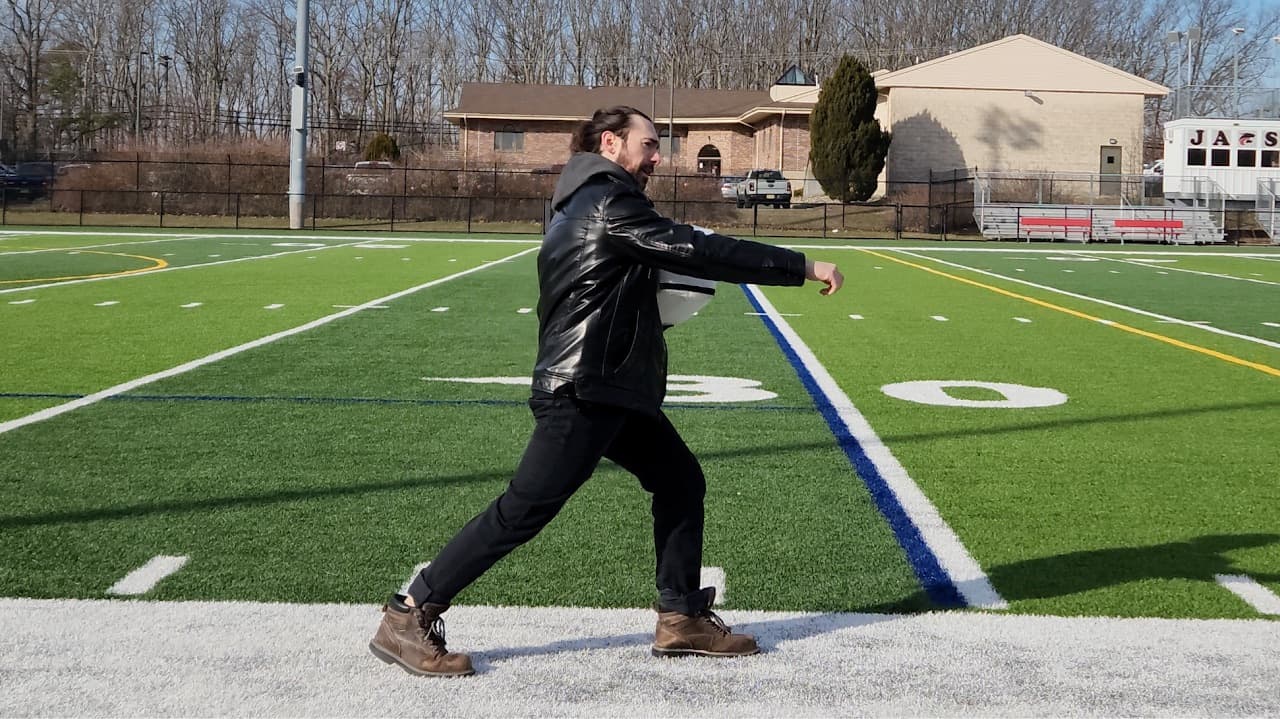
Applied work begins with the athlete in front of Joe, not with a generic template.
Fit before scope
This is specialist work, not another training subscription.
The strongest applications arrive with a real question, enough context to examine it, and a willingness to let evidence determine what happens next.
- Want a generic conditioning plan or motivational coaching.
- Need medical diagnosis, injury treatment, or rehab.
- Expect a guaranteed result before any assessment.
- Unwilling to involve your coach on implementation.
Questions Joe may investigate
The athlete does not need the answer. The athlete needs a useful question.
These public research questions show the territory. An assessment narrows the work to the movement, evidence, and decision that matter for the individual athlete.
01The Myth of the Pivot
Is rotation the engine of your power, or just its most visible symptom?
02Stick the LandingYou train the travel of the punch. What if the damage is decided at the landing?
03Effective MassWhen you land a shot, how much of you actually arrives?
04The F = ma FallacyF = ma describes you accelerating you. So why train it as if the target feels it?
05Milliseconds MatterYour punch happens in milliseconds. Does your training respect that clock?
06Bring Back the BasicsCan heavy, old-school strength build elite striking power without making you slow or easy to read?
The investigation
Evidence before prescription.
The process is designed to avoid turning the first plausible explanation into a permanent training belief. A targeted change earns its place by surviving a retest.
Define the performance question
Agree on one bounded, competition-relevant question worth investigating.
Observe and measure the movement
Use video and measurement to see where usable force may be lost.
Test a targeted technical change
Introduce a specific, reversible change and observe its effect.
Retest and interpret the result
Compare against the baseline and interpret honestly, including null results.
Return practical findings
Hand implementation ownership back to the athlete and coach with clear options.
What you receive
Your Force Signature
Maximizing force doesn't mean swinging harder. It means more of you arriving at the target. Measured, not guessed.
Every athlete who works with Joe leaves with their own analysis: your strikes, measured and mapped, benchmarked against the group, and turned into a concrete path for improvement. The next session can then prove whether the change worked.
- 01Every strike, measured
Force traces of each impact event: what your effort actually delivered, strike by strike.
- 02Peak force, benchmarked
Your maximum strikes against the group average and the group max, so you see where you stand, not where you feel.
- 03The milliseconds at contact
How long your force spends in contact with the target: the invisible window where power transfers or leaks.
- 04A measurable path forward
A baseline to retest against. Change something, measure again, and know it worked. Not hope.
Individual analysis — sample page
Force at impact, strike by strike
Impact events7 strikes
Mean contact time202 ms
Benchmarkvs. group avg & max
In their words
What athletes find once they can see the numbers.
The analysis of where I get power when I jab was really interesting. It surprised me to learn I get power out of my rear leg. Learning the actual force in my strikes gave me a new perspective on how hard they land.
My favorite part was how much data gets recorded and how fast it's analyzed: time between punches, impact force, contact time on the target, even how a strike changes with a roll of the wrist. I'd recommend it to anyone.
With 15+ years in martial arts you see a lot of versions of the same punch. Being able to see a baseline of where you start, and to break down each part of your punch, is a game changer.
It gives you the ability to build a plan to improve the fundamentals and reach the power and speed you want. The experience was fantastic. I'd recommend it to others, and I'm looking forward to seeing how much the data changes next time.
Dr. Natale was great at helping me break down how to generate more force on my strikes: how to connect and disconnect my lower and upper body, when to use them together and when to separate.
He gave me many at-home drills to improve. The slow-motion videos and in-person breakdown have truly been a game changer.
Shared with permission. Individual experiences from real assessments; results vary and are not guaranteed.
Find your track
Where does the strike break down?
Most athletes fight for 1–3% at the margins. The larger gain is usually force you already produce that never reaches the target, and that's where each 2X track begins. Read across, and find the one that sounds like you.
01
“My power lands late, telegraphs, or fades as the rounds go on.”
2X StealthSpeed, disguise, and striking economy
This is me 02“I land clean — but I've never put a real number on my power.”
2X ForceMeasure delivered force, then raise it
This is me 03“I want to hit above my weight, with more of me arriving at contact.”
2X MassPut more effective mass behind the strike
This is me Depth of engagement
Start bounded. Go deeper only when the diagnostic justifies it.
The 2X architecture represents different technical priorities and levels of engagement. It is not a promise that every athlete needs, or qualifies for, every level.
Every engagement begins with your Force Signature. Your strikes, measured, mapped, and benchmarked against the group.
01
2X Stealth · Foundational
Strikers who want speed and disguise before adding load.
- Problem
- Power that arrives late or telegraphs, giving opponents time to read it.
- Scope
- Manage technique and muscle tension to increase strike speed, reduce telegraphing, and improve striking economy.
- Format
- Assessment plus targeted technical work.
- Eligibility
- Application-based. Best after a baseline assessment.
Scope and fees are proposed only after fit and requirements are understood.
Apply for an Assessment02Start with the numbers
2X Force · Standard
Athletes ready to put measured numbers on their striking power.
- Problem
- Effort that is produced but not transferred into the target.
- Scope
- Measure delivered force and work to raise it against a defined baseline, tracking progress in bodyweight-relative terms.
- Format
- Assessment, measurement, and retesting.
- Eligibility
- Application-based. Requires measurement access.
Scope and fees are proposed only after fit and requirements are understood.
Apply for an Assessment03
2X Mass · Advanced
Athletes chasing 'hit like a heavyweight' at their own weight.
- Problem
- Only a fraction of body mass ends up behind the strike.
- Scope
- Incorporate more full-body effective mass into strikes through alignment, timing, and impact mechanics.
- Format
- Custom, multi-session applied work.
- Eligibility
- Proposed only when the diagnostic justifies advanced work.
Scope and fees are proposed only after fit and requirements are understood.
Apply for an Assessment- Applying is free
- No obligation
- You may leave with just a baseline, no upsell
No automatic upsell.
An athlete may leave with a useful baseline and no recommendation for deeper work. A larger engagement should be a consequence of the evidence and the athlete’s objective, not a predetermined sales path.
Working relationship
Specialist depth without taking the athlete away from the coach.
Joe’s role is deliberately bounded. He investigates the question and returns evidence, interpretation, and options to the athlete and coach.
Investigates the defined question
Joe frames the problem, observes the movement, interprets the available evidence, and proposes bounded technical tests.
Supplies context and executes the test
You bring the objective, footage, training history, and honest feedback required to make the investigation useful.
Retains implementation ownership
Your coach remains responsible for the wider program. Findings return to the athlete-coach relationship as evidence and options.
See the work
What Techanique actually does.
Before applying, watch Joe explain the work in his own words. The page describes the structure; the film shows the tone and practical orientation behind it.
What we ACTUALLY do at Techanique Consulting
A 60-second look at the work.
Expectation control
Clear about what the work can and can't establish.
Serious measurement includes uncertainty, null results, athlete variability, and the possibility that the initial explanation is wrong.
A disciplined investigation
- A defined question and agreed scope.
- Honest interpretation of the evidence.
- Targeted changes you can retest.
- Respect for the athlete-coach relationship.
A predetermined result
- No guaranteed force, speed, or ranking.
- No claim that one method fits everyone.
- No medical diagnosis or treatment.
- No deeper work unless the evidence justifies it.
Techanique provides performance and technique analysis. It does not provide medical diagnosis or treatment. Any injury or medical information is handled only as needed and does not imply a medical service.
Questions, answered
The questions Joe hears most, before you apply.
Practice
How is this different from hiring a personal trainer?
There's no long-term lock-in and no per-session billing. Joe takes on a defined problem, solves it, and hands you back to your own training. You keep your coach; you add a specialist for the question that's been stuck.
Do I have to commit to more than one track?
No. You take one track at a time. The three tracks are designed to reinforce each other, but each one stands on its own.
What happens when I finish a track?
You're free to take what you've learned and go, or start another track when you're ready. There's no obligation to continue.
What does “graduation” mean?
You graduate a track when you complete its full cycle. Working through all three opens the door to further work together.
Methods
Will you change my style or my art?
No. Keep your technique. Joe works to enhance how you express it, whether that's boxing, muay thai, kung fu, taekwondo, or karate.
Isn't this karate-based?
Joe's methods grew out of a hard-hitting karate lineage, where he first developed his research approach. The principles of force transfer apply across every striking art.
What kind of exercises or protocols do you use?
A hands-on approach inside your own training environment: targeted testing and drills built around the specific question you bring, not a generic program.
Results
I already hit hard. Why would I need this?
Fair. So let's measure it. Even strong, experienced athletes are usually leaving usable force on the table without knowing it. The point isn't to doubt your power; it's to show you where more of it can actually land.
Are your metrics validated?
Validation is in progress. Joe is documenting the methods as journal-style papers so the work can be reviewed and, in time, published. Public pages describe the questions; the methods stay confidential until they're validated.
How can you add “effective mass”?
Effective mass isn't about gaining bodyweight. It's about how much of your body actually arrives at the moment of contact, and most athletes deliver only a fraction of theirs. Feel the difference once, and the physics makes sense.
Athlete application
Define the question that matters now.
The application is not a checkout. It gives Joe enough context to decide whether there is a useful, bounded investigation to propose.
01
Joe reviews the application
Fit, question quality, available material, timing, and scope are considered personally.
02
A bounded first step is proposed
Acceptance does not automatically mean a long engagement. The initial scope is defined first.
03
Terms and inputs are confirmed
Required footage, attendance, coach involvement, confidentiality, scheduling, and fees are agreed.
04
The investigation begins
The work starts from a baseline and proceeds through observation, testing, retesting, and interpretation.
Bring Joe a question worth measuring.
Every application is reviewed personally. Submitting does not guarantee acceptance.